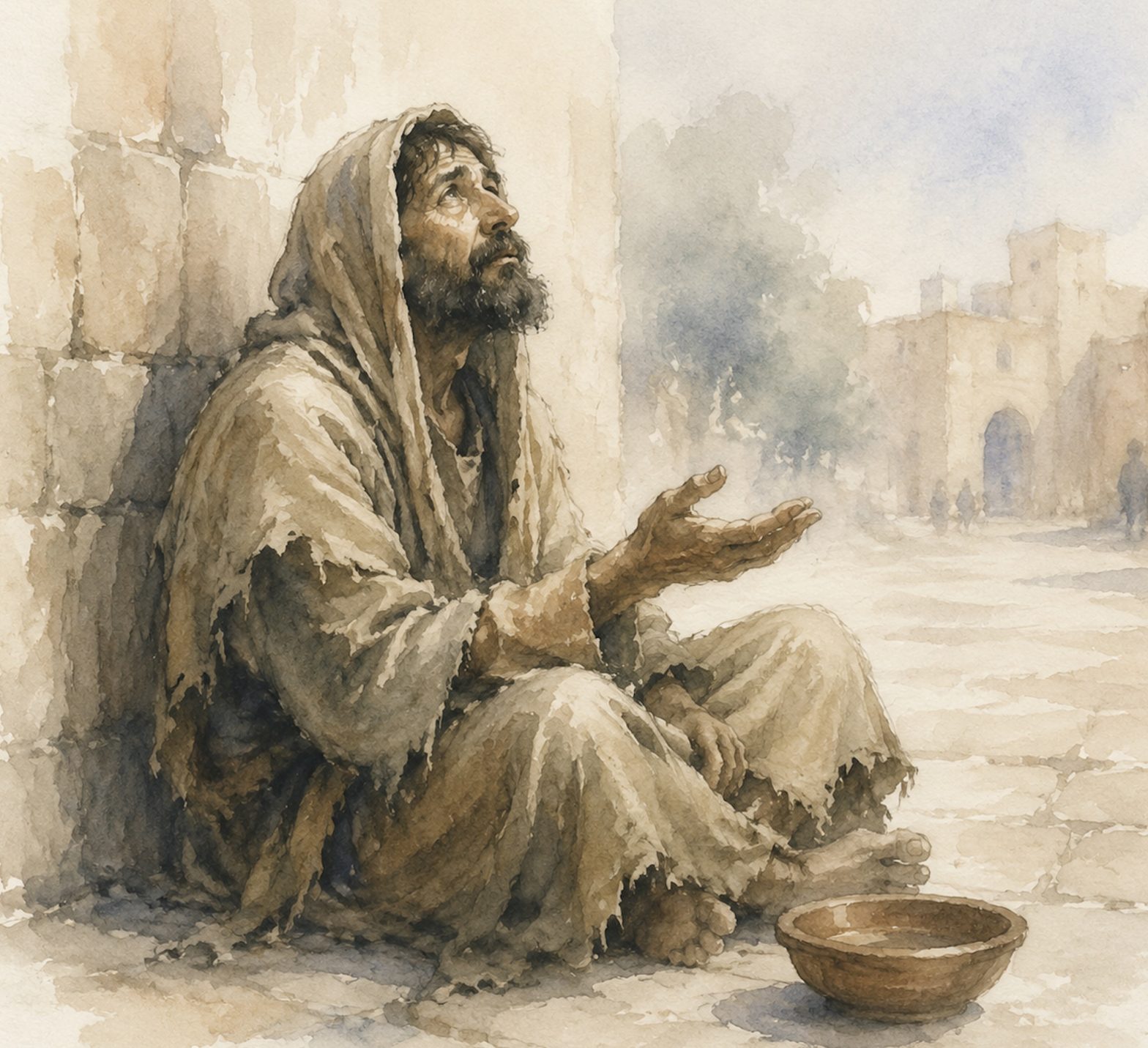
Seeing Life as a Beggar: Recognizing Our Spiritual Poverty
Try to picture the world through the eyes of a beggar. For a moment, set aside your comforts and security, and see life through someone who has nothing. At first, this may feel uncomfortable or even pointless – but there is a purpose to this exercise – to understand the gift of spiritual poverty.
Imagine what it must be like to be utterly destitute. You have no earthly resources. You’re entirely dependent on the charity of others. You have no home, no food, and no money. And to make matters worse, you have no hope that the future will bring relief.
Every day involves a desperate search for the next essential that will help you survive until tomorrow. Comfort and dignity are gone. Security has been stripped away. You live in a constant state of exhaustion, fear, and quiet desperation. You are isolated, ashamed, and unseen.
The New Testament, written in Greek, uses the word ptóchos to describe those who are utterly poor, destitute, and in need. Jesus began His public ministry with these words:
“The Spirit of the Lord is on me, because he has anointed me to proclaim good news to the poor.”
Here, “the poor” does not refer to those lacking earthly riches – it points to a deeper, spiritual poverty that we all share. In God’s sight, we are destitute; nothing we possess or do can earn His favor. Understanding our spiritual poverty reminds us that for eternal life, we are entirely dependent on God’s grace – not on our own works. (Grace here means unmerited, unearned, undeserved favor.)
In short, we are all beggars, completely dependent on what only God can provide.
Why Recognizing Our Spiritual Poverty Matters
In Isaiah 66:2, God declares:
“My hands have made both heaven and earth; they and everything in them are mine. I, the Lord, have spoken! I will bless those who have humble and contrite hearts, who tremble at my word.”
Here, God calls attention to His absolute sovereignty over all creation, reminding us that everything belongs to Him. True blessing comes to those who approach Him with humility – hearts broken by the recognition of their own spiritual poverty. Until we acknowledge our complete dependence on God, we cannot cultivate humble and contrite hearts, nor can we tremble with reverent awe at His word. When we surrender self-reliance, we open ourselves to His favor and guidance, receiving the richness of His blessing.
Jesus echoes this in Matthew 5:3:
“Blessed are the poor in spirit, for theirs is the kingdom of heaven.”
Here, Jesus speaks of those who are spiritually humble – those who recognize that they cannot save themselves and that salvation is a gift from God, not a personal achievement. To be “poor in spirit” is to be broken to the point of abandoning self-reliance, opening the heart fully to God’s grace. In this way, Jesus reveals that the kingdom of heaven belongs not to the proud and self-sufficient, but to those who depend on Him with humility and trust.
Conclusion
Together, Isaiah 66:2 and Matthew 5:3 reveal a profound truth about God’s kingdom: blessing and favor are reserved for those who recognize their spiritual poverty and surrender self-reliance. Isaiah emphasizes God’s sovereignty and calls us to approach Him with humble, contrite hearts that tremble at His word, while Jesus affirms that the kingdom of heaven belongs to the “poor in spirit” – those who fully depend on God for salvation and guidance. Both passages underscore that true spiritual life isn’t based on pride or self-sufficiency, but rather humility, brokenness, and an open heart ready to receive God’s grace.
Being a beggar – spiritually destitute – is not a temporary phase to outgrow; it is the ongoing posture of the soul that keeps us clinging to God’s grace rather than drifting into self-reliance. Even our guilt can serve as a reminder when it drives us back to God empty-handed – “Lord, I don’t even have the desire or consistency I wish I had – please feed me anyway.” That is the Spirit gently guiding us to recognize our dependence.
To live in humility is to admit, moment by moment, that apart from God we have nothing, that our default is shortfall, and that our purpose is not to impress Him but to receive from Him. In this continuous awareness of our spiritual poverty, we remain open to His blessing, sustained by His grace, and anchored in His kingdom.
Related: The Wonderful Jesus The Christ